Arizona Gila Monster
Last updated on .
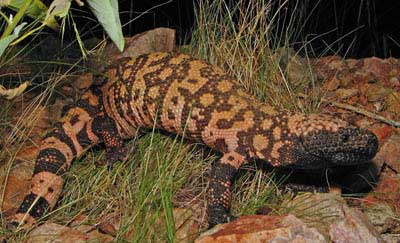
Gila monster is one of Arizona’s most famous reptiles and the only native venomous lizard in the United States. Recognized by its bold black-and-orange pattern, thick body, and slow deliberate movement, the Gila monster lives in desert and foothill habitats across parts of Arizona. Although widely feared, these reptiles are generally secretive and spend much of their lives underground. Seeing one of these wildlife specimens in the wild is considered a rare and memorable Arizona wildlife experience.
The Gila Monster is the only venomous lizard in America. Pronounced as "Hee Lah", the Gila Monster is also the largest lizard in the country and is unique only to the Southwestern states and northern parts of Mexico. It is related to the "Mexican Beaded Lizard" which inhabits areas of northern Mexico. The Mexican Beaded Lizard is also venomous. The Gila Monster is brilliantly colored with a black body marked with vivid colors of orange, yellow and pink. The average adult Gila Monster can reach a length of about 16 to 24 inches and can weigh up to 5 pounds. It is a threatened animal with diminishing numbers. It is federally protected making it illegal to capture or kill.
Where to See Gila Monsters In Arizona
Gila monsters, like the horned lizard, are most often found in rocky desert areas, washes, cactus flats, and foothill habitats in southern and central Arizona. Good regions include portions of the Sonoran Desert near Phoenix, Tucson, Mesa, and rural desert preserves where natural habitat remains intact. They are usually most visible in spring and early summer, especially on mild mornings after emerging from burrows. Because Gila monsters are protected wildlife, always observe from a distance and never disturb or handle them.
How Venomous is the Gila Monster?
Yes. It is venomous. Its bite can be very painful and serious, but rarely is fatal. Depending upon which report you may read, the last death recorded from a Gila Monster bite was in 1939 while others report no deaths in the last 100 years. That could be because the Gila Monster bites very few people. It is very secretive, lives 95% of its life underground in burrows is very slow and is not aggressive. Unlike rattlesnakes or scorpions, there are very few "surprised" accidental bites by a Gila Monster. To be bitten, a person would almost have to pick up and handle a Gila Monster. Although very lethargic, once in or around your hand, a Gila Monster can bite very quickly.
Its venom is a mild neurotoxin and similar in toxicity of the Coral Snake. Unlike venomous snakes that inject venom with fangs, the Gila Monster latches on to its victim with strong jaws. It releases venom through hollow teeth from venom glands at the bottom of its mouth and injects venom with a "chewing motion" into the wound. When bitten, the victim must remove the Gila Monster quickly to minimize the amount of distributed venom. Because they "hang-on", it often loses some of its teeth when yanked-off. If near water, the victim can submerge the lizard to break free of its continued bite.
As a neurotoxin, the venom attacks the nervous system. Again, deaths from Gila Monster bites are very rarely life-threatening but are mostly dangerous to infants and the unhealthy. Symptoms are severe pain, weakness due to a rapid drop in blood pressure and swelling. In some cases there could be partial, temporary paralysis of limbs and even hemorrhaging of internal organs. So, always seek emergency treatment.
What To Do If Bit By A Gila Monster
- Seek emergency medical care immediately.
- Move away from the animal safely.
- Stay calm and limit movement.
- Remove rings, watches, or tight clothing before swelling begins.
- Wash the wound gently with clean water if possible.
- Do not attempt to pull the lizard aggressively if still latched on.
- Do not cut the wound or attempt to suck out venom.
- Do not apply ice or a tourniquet.
- Monitor breathing, swelling, weakness, dizziness, or severe pain.
- Follow medical professionals’ instructions promptly.
Gila Monster Facts
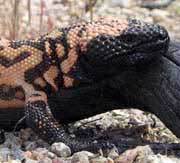
The Gila Monster is a gorgeous creature. Its head is large with small beady eyes. The tail is short and fat and used to store fat so they are able to go months between meals. They feed on eggs of other reptiles and birds, and will eat small newborns.
They spend 95% of their time living in underground burrows only emerging to either feed or bask in the sun near the entrance to their burrow. During the heat of summer they are generally nocturnal, but when pleasant temperatures arrive they become active during the day. In the winter cold months, they become somewhat dormant.
Gila monsters are oviparous, meaning that they lay eggs. The typical "clutch" size is five eggs but they can lay up to twelve eggs at a time. In southern Arizona, Gila monsters breed in May and June and lay their eggs in June and August of the following year. These eggs then incubate in burrows and develop from fall to the early spring, and young appear in April and June. Interestingly, no other egg-laying lizard in North America over-winters their eggs and hatches them the following year. The gestation period of a Gila monster is 42-55 days.
Don't Touch
If you come across one of these amazing creatures, consider yourself lucky. Very few people will ever see one in the wild. If you do, keep your distance and just observe this beautiful reptile. Generally, a bite from a Gila Monster only occurs when people try and handle them. And remember, they are on the protected list, so do not harm them.
When Gila Monsters Are Most Active In Arizona
- Spring (March to May) Peak visibility season as temperatures warm and lizards emerge from winter dormancy.
- Early Summer (June) Active during mornings and evenings before extreme heat builds.
- Monsoon Season (July to August) Occasional activity after rains, especially during cooler periods.
- Fall (September to October) Activity tapers as temperatures cool.
- Winter (November to February) Mostly inactive underground in sheltered burrows.
Arizona Animals